Itera caught my fiber gap on day 28. A week later my mornings were different.
By Dzmitry Baranau, Founder, Itera
On day 28 of using Itera, the Patterns tab redesigned itself. The first card I landed on was Fiber, and it showed me the lowest day of my week. I added two foods. A week later something I'm too polite to spell out had genuinely improved, and I started taking the chart seriously.
I built Itera because I wanted a tracker that learned me, not one I had to feed. By the end of April I'd logged 194 meals across 35 days. Logging was already faster than MyFitnessPal had ever been for me. What I didn't expect was for it to also catch something about my own eating that I'd missed.
The day the new feature appeared
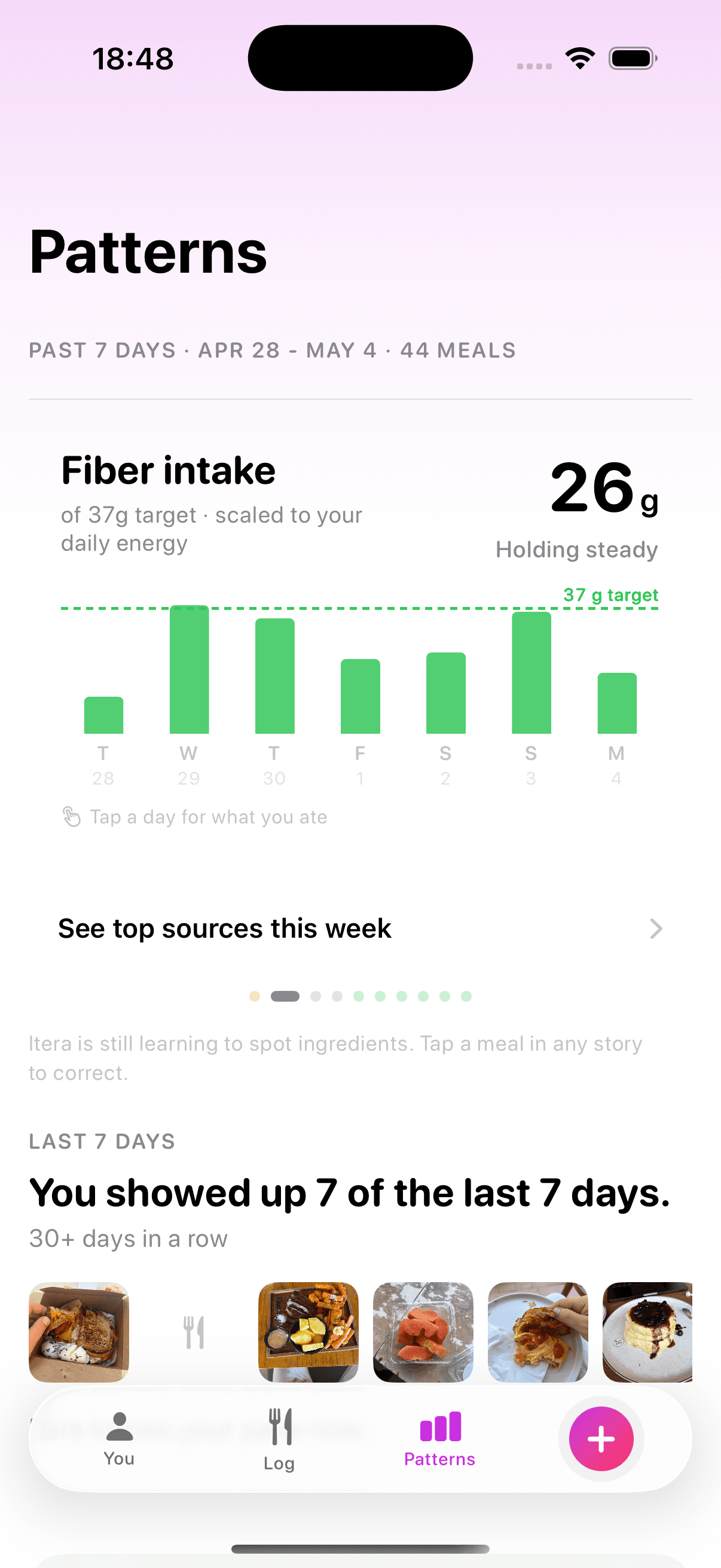
On April 27th, the Patterns tab got a redesign. The new view was simpler than I'd expected: one nutrient per card, a weekly bar chart, a short sentence above it calling out the trend. I opened it that morning, swiped past Vitamin D (low according to Itera, but I live in Bali and walk in the sun every day, so the dietary number means less here), and landed on Fiber. The chart ended with a clear dip.
It was my lowest fiber day of the week. Below the target by enough to make me actually look.
What I did with it
I tapped “See top sources this week” and scrolled the ingredients list. Avocado was doing almost all the work. I eat it daily, so it adds up. Beyond that, nothing else was helping. No whole-grain breakfast. No legumes at lunch. Almost no fruit outside the bits in salads.
I made two changes:
- More avocado. Bigger portions, sometimes a second serving later in the day.
- Oats back in the mornings. A small bowl. I'd cut them out months ago for no real reason.
That was it. Two foods, no supplements.
What changed
Within a few days my mornings felt different. I'm going to be careful here because people don't really write about it: regularity. The kind of improvement you'd only really clock if you suddenly got it back, and miss the second it left. That's what changed. Afternoon energy was steadier too, but afternoon energy is affected by ten different things. Coffee, sleep, meeting load. The digestion change felt more directly tied to the food.
What most calorie trackers won't do
Every tracker I've used for ten years can show a fiber number. Almost none of them surface it as a question worth answering. MyFitnessPal puts micronutrients behind a paywall and a few taps. Cal AI doesn't track most micros at all. Cronometer has the data, but you have to know what to look for.
Itera does it differently. One nutrient per card. A short sentence about how the week is going. A weekly chart. A list of which foods made up the number. That single-card layout is why I noticed. A wall of micros would have washed past me like it always had.
One honest caveat
Not every low in the Patterns view is a real gap. Vitamin D is the example I keep coming back to.
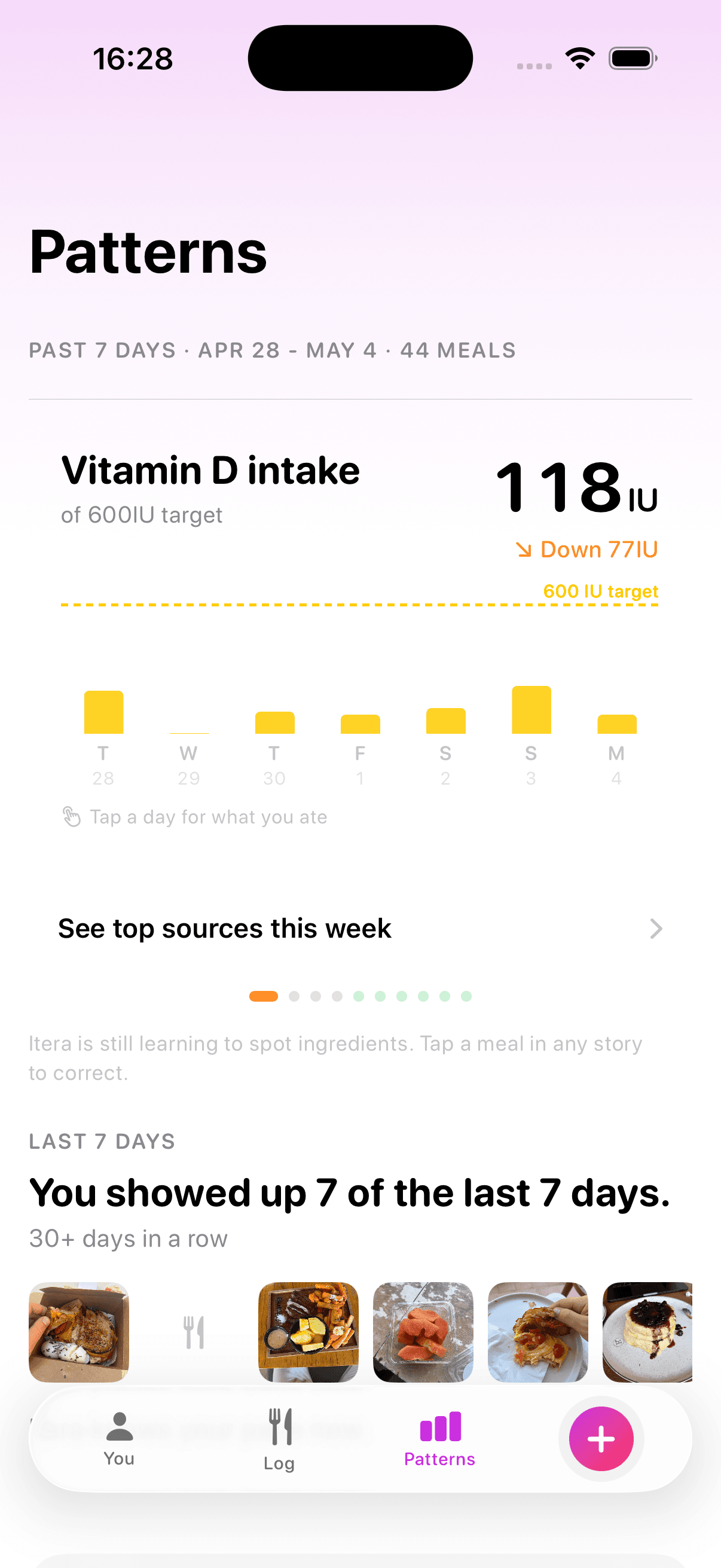
My dietary intake is low. That's true. But I live in Bali, I walk in the sun, and a calorie tracker can't see sunlight. So before you act on any flagged nutrient, ask whether the body actually gets it from food in the first place.
Fiber is a food thing. So are iron, magnesium, and most trace minerals. Vitamin D leans heavily on sunlight. Hydration and electrolytes lean on what you drink. Those numbers need context before you act on them.
What this is, and isn't
This is one founder, 35 days into his own app, noticing one thing and changing one thing. Not medical advice. Not a study. Just the kind of feedback loop most trackers don't bother to give you.
Itera is on the App Store if you want to try it. The free trial is two weeks. Roughly how long it took me to start noticing my own patterns.
TRY ITERA
See what your own week is missing.
Two-week free trial. iPhone only.